
Frontend · Aug 2026
Wilmot's Warehouse
Unofficial promotional landing page for the co-op board game Wilmot's Warehouse, where the visitor learns the rules by playing.
Overview
Wilmot's Warehouse is a co-op board game where players stock a warehouse together and have to remember where everything went. I built the hero, the how-to-play tutorial, the navigation and the kit section of an unofficial landing page for it, and Fernando Manuel built the footer, the player quotes and the gallery. Two weeks from first commit to finished page. The game, its artwork and its copy belong to its creators and publisher.
The hero is the product
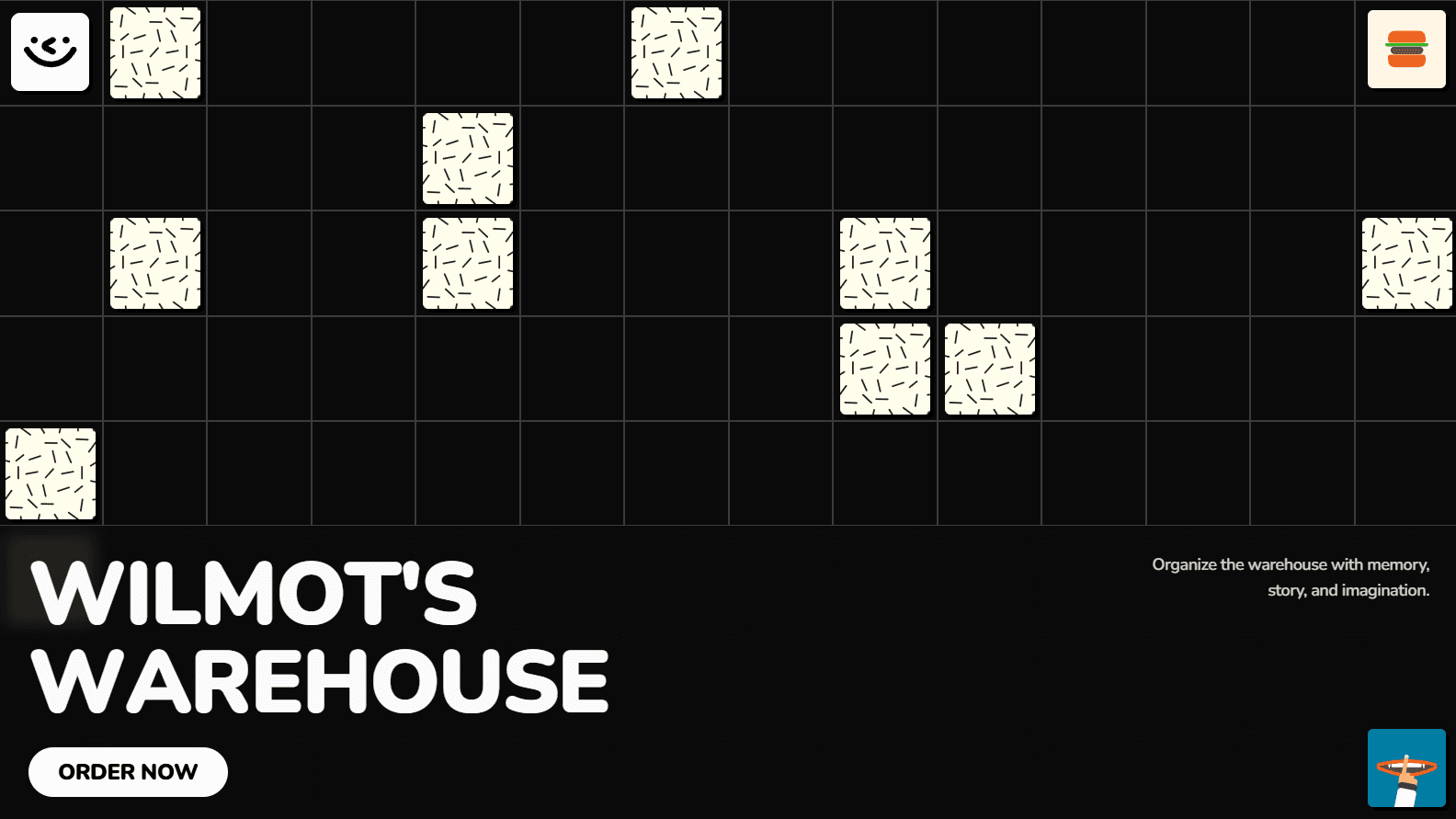
The page opens on a live grid of the game's product tiles instead of a headline. It follows the pointer on a mouse and works out its own size for every screen, so the first thing a visitor sees and touches is the thing being sold.
Learn by playing
Rules are hard to read and easy to play, so the how-to-play section is a small board instead of a rulebook. The visitor drags a customer card onto the right tile, the score moves, and speech bubbles explain each step as they scroll. I rebuilt it from a static first draft into the playable board in a single day.
Draw & place
Discuss & strategise
Open the next day
Repeat until empty
Start the timer
Calculate score
Motion approach
Smooth scrolling runs through Lenis on GSAP's clock, so scroll-linked motion and the tutorial steps share one timeline. Scrolling locks while the menu or a sheet is open, and the description section respects reduced-motion settings.
Two people, one page
Fernando Manuel and I brainstormed the page together, then split it by section. He is creative, open-minded and eager to learn new things, and the background music, switched on from the bottom-right corner, was his idea. On the last day I moved both halves into one structure, with each section's copy in its own typed file, so the finished code reads as one project rather than two.
- Navigation and menuMe
- Hero tile gridMe
- DescriptionMe
- What you getMe
- How to playMe
- GalleryFernando
- Player quotesFernando
- Footer conveyorFernando
- Me
- Fernando Manuel
Behind the scenes
Let visitors play the game before they buy it
Why: People choosing a board game look for reviews and play-throughs before they commit. A playable board lets them try it first-hand on the page, so the page does the job a review would instead of describing rules they still have to imagine.
Split the page by section, not by task
Why: Giving each of us whole sections made the work easy to divide and to merge back together. Fernando was still in college, so owning complete sections also let me mentor him through his while building mine.